The Weird Art of Helen Martins and the Owl House

This is an edited version of an essay that first appeared in The Decadent Anchorite, the journal that I publish for the Esoteric Order of Dagon amateur press association, an APA dedicated to the study of H.P. Lovecraft and weird fiction.
Outsider Art
To keep body and soul together I work in the IT department of a large medical university. Although I am now a manager, and don't get out in the hospital much, I used to go anywhere that there was a technology problem that needed fixing. It took me out of my comfort zone as I had to work in operating rooms, the emergency department, patient and exam rooms, among other less daunting environments. However, because of security restrictions, I never worked in our inpatient psychiatric unit. This unit, as it was on the northwest corner of one of the older buildings on campus, was usually referred to as 1NW.
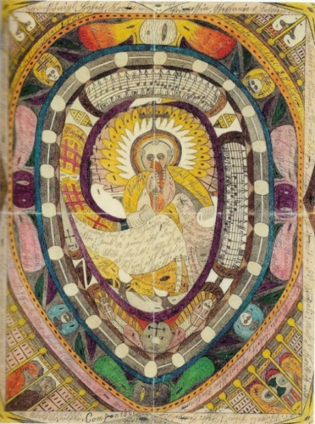
A few years ago, many Portland hospitals collaborated to open a new, larger psychiatric inpatient unit, and 1NW was closed. I visited the unit afterwards to clean out the computer and related equipment that has been left behind. In doing so, I came across another discarded item—this painting:
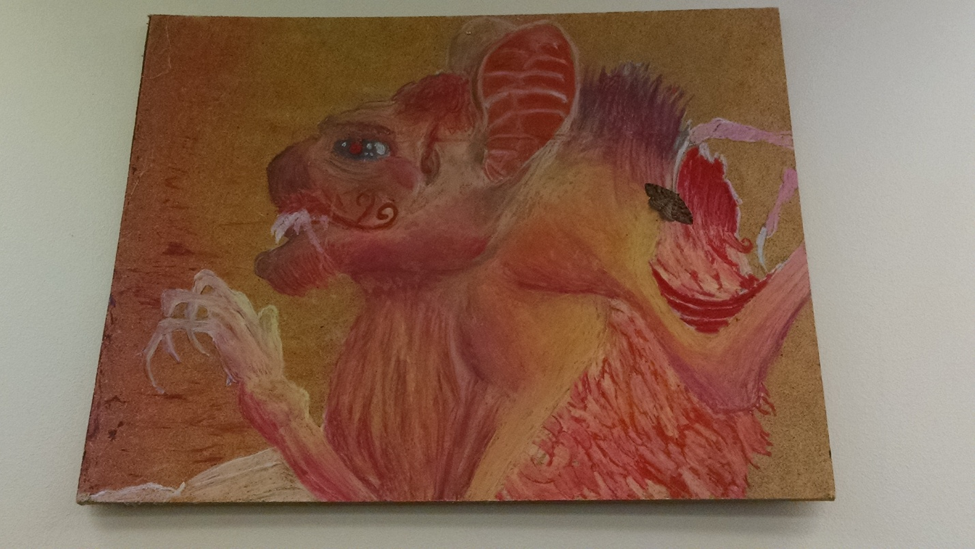
I was immediately drawn to it, and hung it on the wall of my office. I imagine that it was originally art therapy for one of the patients in 1NW. It certainly is a striking piece. When it became time to leave my campus office to work from home full-time, I debated taking the painting with me. But I was loathe to remove the painting completely from the hospital, thinking that perhaps it was meant to stay there, as part of the rich history of the place. Unfortunately, the person that moved into my old office did not have the same appreciation for the piece, preferring to adorn his walls with motivational posters. The painting was removed and set aside, perhaps even thrown away. In any event, nobody knows its current location.
The painting is representative of what has become known as Outsider Art. This has become somewhat of a catch-all term for art that is done by people outside the established art world, who often have no formal art training, and who usually are not professional artists, nor are looking to sell their work or make a name for themselves. Indeed, mentally ill people in sanatoria were among the first recognized outsider artists, and their output was originally classified under the umbrella of Art Brut. These works were initially studied and collected for diagnostic purposes—to aid in the understanding of mental illness, especially schizophrenia. The first major collection of these works were assembled by the Swiss psychologist Hans Prinzhorn, who in 1922 wrote the book Artistry of the Mentally Ill and assembled a large collection of works that became known as the Prinzhorn Collection (Rhodes 2022). Since then, similar collections have been assembled across the world.
Even those outsider artists who are not actually labeled as mentally ill, or residents in care facilities, are usually seen as strange, eccentric, a bit off. This can be due both to the nature of their work, and their presentation to the world. Their art is done as a means of self-expression for its own sake, without expectation of monetary reward or praise, and the self that they express is sometimes rather out of the ordinary. Further, outsider artists often (but not always) work with media a little out of the usual—found or discarded objects, ballpoint pen or crayon, even string and twigs, and the like.
Creating the world
Another aspect common to many outsider artists is that their output is often an attempt to create a new world in which they can live, or at least visit imaginatively or physically. For instance, writing of Adolf Wölfli, one of the best known of the Prinzhorn artists, Rhodes (2022: 80-81) notes that, "…all Wölfli's visionary adventures around the world in the piece of autofiction From the Cradle to the Grave (1908-1912) take place before the death of his mother… as soon as Wölfli was left to himself or voluntarily detached himself from his surroundings, he turned inward into his own universe in which he lived and which was 'more authentic for him that the real world.'" His stunningly complex paintings are all representations of that inner world that he inhabited.
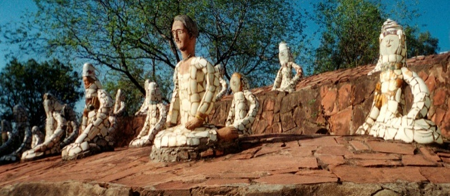
However, the creation of elaborate worlds is not only done by outsider artists experiencing mental illness. One of the most famous was the Indian artist Nek Chand, who had a stable job with the Indian Public Works Department, as a road inspector. From 1958-1974 he secretly created his Rock Garden on public land outside the city of Chandigarh, where it remained undiscovered for many years. The result was a village, which he named Sukrani, populated by figures of people created from cement and discarded objects. As the work gradually became known, the government bowed to popular pressure and turned the Rock Garden into a public park, and employed Nek Chand and a number of workers under him to maintain and expand it. Today Nek Chand's secret outsider art project is a popular tourist destination.
Digression One: Outsider Art and Amateur Journalism
It would be pushing it to say that ajay can be seen as a form of Outsider Art. However, they do share some undeniable similarities. Both operate largely outside of the mainstream, whether that be the art gallery or the publishing house. Or, to put it in terms of the cybernetic principles in which I have increasingly come to view the world, they are both driven by a self-regulated compulsion to create, rather than responding to societal or commercial feedback loops. This manifests as a strong DIY spirit in both. The outsider artist scavenges materials are on hand, and the amateur journalist often makes use of their own letterpress or the library printer.
Of course, you can make too much of the similarity. Outsider artists by and large don't form organizations like amateur press associations, although mail artists similarly distribute their output through the postal system. However, I can't help feeling that there is something of the spirit of the outsider artist in the amateur journalist.
Helen Martins and the Owl House
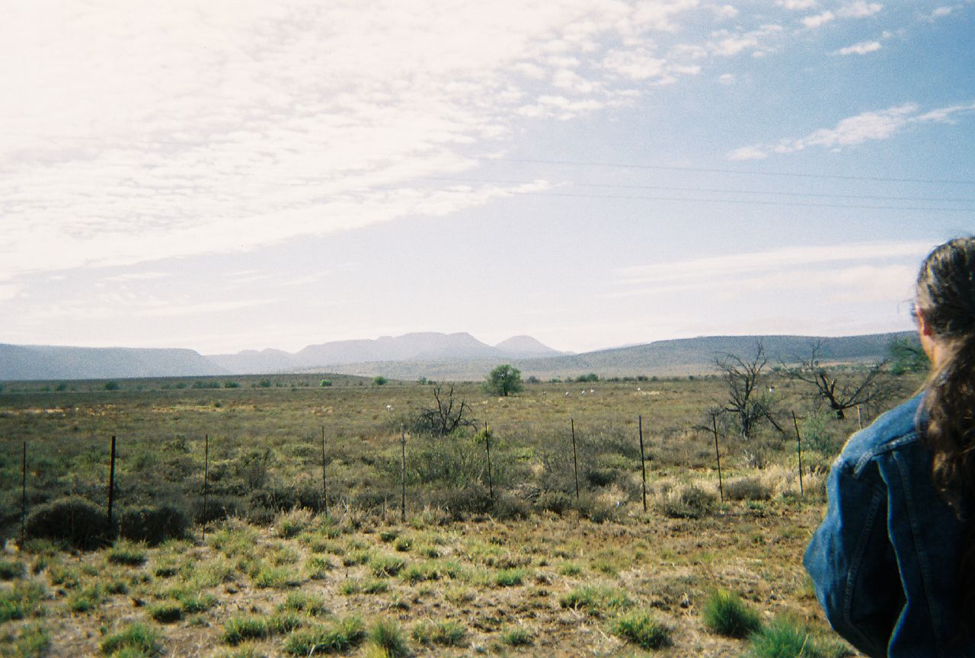
Helen Martins was born in 1897 in the tiny Karoo town of Nieu-Bethesda, in the Karoo. The Karoo is a beautiful semi-desert region in the interior of the Cape Province, South Africa. Like many harsh environments, it has attracted both those who do not fit well into urban environments—tough libertarian farmers, artists, loaners. The type of people that you meet in the Karoo today are not unlike those you encounter in rural New Mexico.
Nieu-Bethesda is small even for Karoo towns, and out of the way. Even today (or, more precisely, 2005, which was when I last visited) it takes an hour drive to get there over dirt roads from the town of Graaff-Reinet, which is of itself no great size. It is well worth the visit. Situated in a fertile valley, the populace still lives in the original Cape Dutch houses that their ancestors bult. Dominating the entire village is a very large and attractive Dutch Reformed Church. Seeing the village for the first time, I felt something akin to what Lovecraft felt when visiting Marblehead. It was as if I had stepped into the past.
As beautiful as it is, for Helen Martins it was something of an stifling environment. In the early twentieth century, the local school just went up to Standard 7, after which most pupils left to help run the farm. And the dominance of the strict Calvinist ideology of the church was oppressive. And, worst of all, Helen's father, Piet Martins was a thoroughly nasty piece of work, hated throughout the area. He made Helen's life miserable in many small ways. It is said that whenever she received mail, and he was able to intercept it, he would first taunt her with it by waiving it in front of her face and then would tear it to pieces.
Small wonder, then, that she sought escape by an early marriage. Her husband, Johannes Pienaar, was a rare bird for Nieu-Bethesda—a rebellious freethinker (they were not allowed to be married in church), an intellectual, and very handsome. They escaped the stultifying social environment of the Karoo and moved to Johannesburg, where for a while they acted in the what was probably the first wholly-Afrikaans theater troupe. Unfortunately, Johannes was both given to having numerous affairs from the very beginning of their marriage, and got into debt to boot. To flee the debt, he emigrated to London, where he eventually became an artist and politician. Helen moved for a period to Cape Town where she worked first as a teacher and then a pharmacist, then returned to Nieu-Bethesda to take care of her aging parents. She would never leave.
In total, Helen looked after her parents for sixteen years—both her mother and father for thirteen, and then her father alone for three more. Although both of them eventually died of cancer, they had various infirmities before that disease finally took them. While Helen was devoted to her mother, she hated her father. And the feeling was mutual—he refused to be even in the same photographs as Helen. Even before her mother died, Helen painted one of the rooms of the house black, put a sign above the doorway labeling it "The Lion's Den" and moved her father in. She rarely entered it again, leaving it to others in the village to wash the infirm old man and clean his clothes. Nor did she enter it after his death, and the room remains painted black to this day.
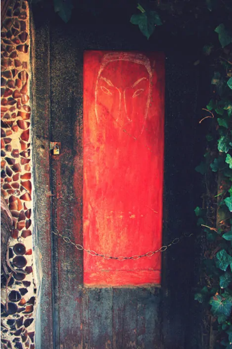
By now Helen was thirty-seven, and it is here that her story really begins. If she had left Nieu-Bethesda, or settled down to marry a stolid but dependable farmer, perhaps she would have been happier. But she would not have created the remarkable outsider art, a world of her own creation, that has become known as the Owl House.
Years later, Helen related to sister that she was lying in bed one night, looking at the moon through her window, and got to thinking how dull and grey her home was, and how much she wanted brightness and light. Her solution was quite unique. Apart from enlarging the windows, she ground up colored glass bottles in a coffee grinder and applied the ground up glass to a wall in her house. The affect of the sunlight on the colored glass was just what she was looking for. She paid the village children a small amount of money to find colored bottles for her and even had glass manufacturers send her materials. She applied the crushed glass to just about every part of every wall in the house, except for the all-black Lion's Den. At night, when all the candles in the house were lit, the light shining off the glass covered walls and reflected in the many mirrors, the effect was striking.
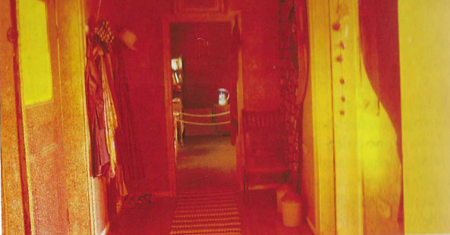
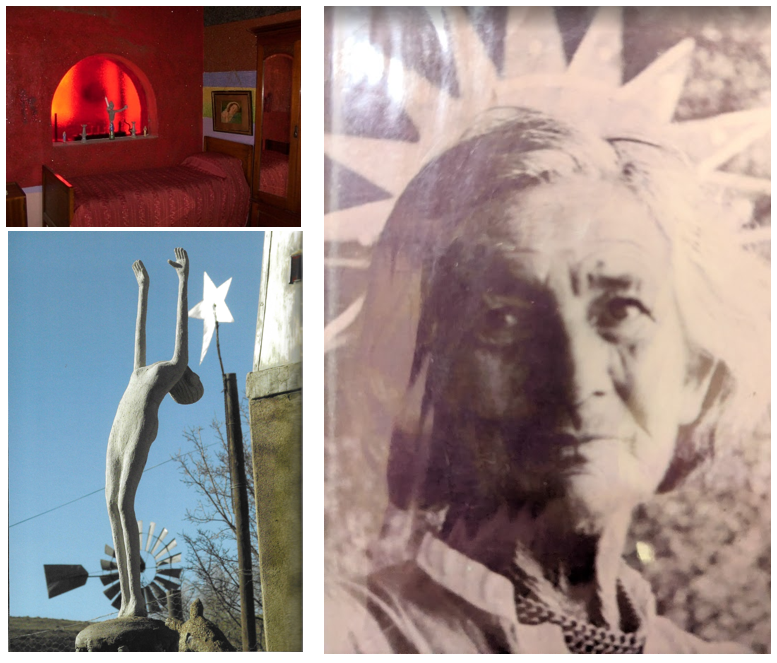
She also began to accumulate things that she considered beautiful —mirrors, pictures from the land of the bible, many candles of various sizes. Some of the mirrors she had specially cut in the shape of suns and moons and stars. The house was filled with reflected light, from the sun shining through the windows and from the candles. Too, she began arranging the art and furniture in a way that was meaningful to her, and the various rooms were given names. For example, in the Honeymoon Room, decorated as a bedroom, but in which Helen never slept:
"The ceiling and (one) wall are both bright red. The other three walls are painted in irregular stripes of red, black, brown, mauve, yellow, and pale green. All the walls glisten with glass… on top of one of the beds lie two black dolls in an everlasting embrace…" (Ross 1997:66).
"…on the window is one of the suns visible from the stoep. It is the sun 'with the jealous eyes', according to Helen. The jealous eyes are green, with yellow centres and they unceasingly and possessively survey this room, intended for the union of newly wed lovers… A striking and unusual feature of this Honeymoon Room is the absence of a double bed. Instead we find two single beds separated by a wardrobe. When Jill Wenman queried Helen about this, she replied enigmatically, 'Ja, but that is just life. Love is always kept apart.'" (Emslie 1997:50).
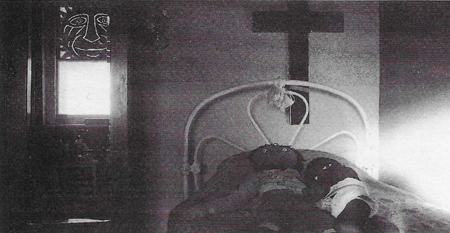
The rest of the house is similarly decorated. In the words of one visitor, "It is very difficult to describe the impact made when one first approaches, and then enters, the Owl House. One of the many emotions to be registered could be shock, then disorientation and claustrophobia, it is so unexpected and unfamiliar, and so filled with sensations and objects. Only after a few visits does one have enough familiarity to start absorbing an impression of the interior as a unit —let alone its details. The colour everywhere is overwhelming, as is all the reflected light; but the atmosphere is oppressive, with no feeling of happiness. One is also likely to have a feeling of reticence about intruding in a home that was so clearing private…" (Ross 1997:58).
In this short essay, I do not have the space to do justice to the artistry of the house, nor to reflect on the intricate and personal symbolism of Helen Martins. Each room is themed, and filled with items and pictures that were meaningful to the artist: suns and moons, with or without faces, small concrete owls, prints of art works, many shaped mirrors, figurines, jewelry. And, discovered after Helen's death, more personal items that she kept: beautiful clothes, art photos, including many nudes, more jewelry, feminine beauty items. That they meant a great deal to Helen is shown by a line in her will that specified that her clothing and jewelry were not to be given away after her death, but kept with the house.
Digression Two: de Montesquiou, Des Esseintes, Lovecraft, Helen Martins
Most people appreciate beauty. Some make it part of their lives, furnishing their homes tastefully, admiring art in museums, attending concerts, buying beautiful books. But for the most sensitive of aesthetes, being surrounded by beauty in their waking hours is a necessity rather than a luxury, because the ugliness of the world is intolerable. Life is only worth living, only able to be experienced in its fullness, when all of one's being is able to sensually, ecstatically, commune with beautiful and meaningful things.
Thus the arch-aesthete Robert de Montesquiou designed his home in the Quai d'Orsay to be something akin to an ecstatic assault on the senses. For instance, to approach his rooms, visitors had to ascend a "forest passageway" draped in antique green tapestries with sylvan motifs, stepping on a moss-colored, textured carpet. At the top of the stairs, the doorbell was a cord made of interlocking bronze monkeys, and the door was opened using a rococo cane handle as a knob (Beaulieu 2023).
Thus in Au Rebours, Jean des Esseintes designs his house in such a way that he need never see or hear anyone else at all, and can commune with his carefully chosen art, literature, perfumes, liquors without exposure to the ugliness and banality of the outside world. And for Lovecraft too, surrounding himself with beautiful things was essential. Though for him it was the furniture, books, and other objects that had been in his family for years, and that provided a link with the past, rather than the more outré aestheticism of de Montesquieu.
And so on for sensitive aesthetes everywhere, including Helen Martins in a small village in the Karoo. However, her own sense of beauty ran closer to the lush sensuality of de Montesquiou rather than the quiet aestheticism of Lovecraft, which could engender in others a sense of disorientation rather than a welcome feeling of homeliness.
The Camel Yard
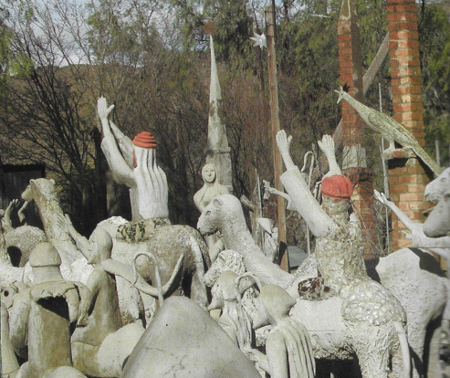
After a period of turning the interior of her house into a work of art, Helen turned her attention to the outside. What she had in mind was an extensive sculpture garden. However, she lacked both the material and the training to produce sculpture on the scale she was visualizing. To get around this, she employed local laborers to work in concrete, the material with which they were most familiar. The result was the Camel Yard, a remarkable collection of large concrete sculptures of animals (predominantly camels), biblical scenes, people, and miscellaneous other objects. While perhaps not as vaguely disturbing as the house, the massed effect is still nonetheless weird. Typically there is little conversation as one walks around the Camel Yard, as one tries to take in all the detail and make sense of it. Certainly, interacting with Helen Martins' creation, both inside and outside the house, seems to me akin to engaging with Lovecraft's fiction in the manner described in Harman's (2012) masterly analysis. Although there are numerous photos of the Owl House and Camel Yard online, they cannot come close to capturing the experience of being there in person.
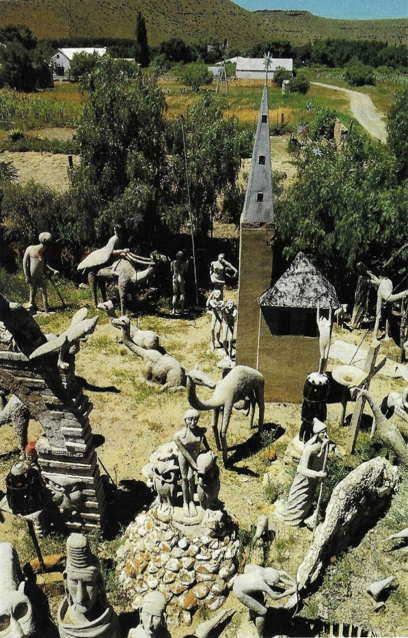
Although at first glance all large concrete statues seem to be massed together in a somewhat overwhelming crowd, there are discrete areas in the camel yard. As one enters through the gate, one is greeted by two "hostesses" —ladies in large hoop skirts adorned with bottles. In the center is the Bennu bird from Egyptian mythology. Further on, there is another section with Egyptian theme —a series of pyramids. And on one of the walls is a concrete mural with figures reminiscent of Babylon or Ninevah. Elsewhere, there are three life-size camel riders that hold up their hands in adoration —the three wise men on their way to greet the infant Jesus. Close by is the meditating symbol of an Indian yogi.
Elsewhere are single figures —shepherds holding sheep, or figures of animals like lions, birds, camels, or even weird therianthropes. One such human-animal sculpture is in the little section known as the "Center of Debauchery". As described by Anne Emslie (1997:89): "In the foreground a gluttonous creature, half-cock, half-man, has been caught with his pants undone. Having over-indulged and now too fat to do up all his buttons, he finds himself in trouble. Behind him is a tavern scenario. On of Helen's elegant bottle-skirted meisies offers alcoholic refreshments to a seated figure whom we can imagine is inebriated.
It is impossible to do justice to the Camel Yard, or the Owl House interior for that matter, in the space of an essay. Anyone wanting to get some idea of how the house, now a museum, looks can look at the various photos available online. But that will still not come close to the experience of seeing it firsthand.
Koos Malgas
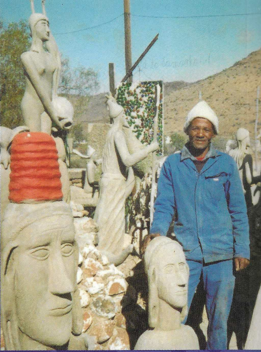
Helen Martins is recognized as the creator of the Owl House, but perhaps it would be more accurate to call her the co-creator. She was not able to work in concrete, not having the skill or the strength, especially as she got ever more frail as she aged. She employed a number of men from the nearby Coloured township to give her artistic vision concrete form.
Her longest running collaborator was Koos Malgas. Originally a sheep-shearer, he worked with Helen for twelve years, and they became friends. In fact, he remained with her until her death.
Nor does it seem like it was simply a case of Helen telling Koos what needed to be done, and then him reproducing it in concrete. Rather, they discussed the work together, usually over morning coffee. Helen also visited Koos and some of her other Coloured friends in the township, something which was frowned upon. Indeed, it was said of Helen that "She liked many of the brown folk too much" (Ross 1997:55) and this contributed to her unpopularity with most of the town.
In her compassionate tribute to her grandfather, Koos Malgas: Sculptor of the Owl House, Julia Malgas relates how Helen gave him a letter to be opened in the event of her death. As he was illiterate, Koos took it to the local minister to read. The latter, having read it, told him that it did not concern him, and refused to tell him what it contained and would not return it. It is possible that Helen had given him the Owl House, but of course we will never know. Certainly Koos, a poor Coloured man, was in no position to take the matter further.
The Death of Helen Martins
As she grew older, Helen got increasingly frail. Like Lovecraft, she had a poor diet. She spent most of her small pension on Koos Malgas' salary, and subsisted largely on coffee and bread. And there was a growing animosity between her and the rest of the village, although she did have a few friends. Sometimes people would bring her plates of food and try and make her eat a meal, but she largely left them untouched.
However, far more importantly, she was also going blind. She never wore any eye protection while grinding up her glass, and is possible that minute slivers penetrated her eyeballs over the years. Or perhaps it was a natural result of aging and poor diet. In any event, to no longer be able to see the beauty of her world and of nature was intolerable to Helen. She committed suicide in 1976, at the age of 78, by ingesting caustic soda. It was a long, agonizing death and she passed away in the hospital at the nearby town of Graaff-Reinet.
The Owl House as Weird Art
One might wonder why I would write about Helen Martins and the Owl House in this journal, which is part of an amateur press association dedicated to H.P. Lovecraft and related subjects. Obviously, nobody in the Lovecraft circle was aware of her work. Nor has it drawn attention from subsequent scholars of weird fiction and art.
However, it is my contention that the interior of the Owl House, the sculptures of the Camel Yard, can be seen as an example of weird art, similar to the sculptures of Clark Ashton Smith. The definition of weird art is very slippery indeed. Perhaps it resists categorization because to some extent it refers to the intrusion of something that should not be there. To paraphrase Justice Stewart, one may not be able to adequately define what art can be classified as weird, but you know it when you see it.
This is better expressed by Mark Fisher, who studied with Nick Land at Warwick University and was one of the other leading lights of the CCRU. In the opening of his book The Weird and the Eerie (2016), Fisher wrote, "What is the weird? When we say something is weird, what kind of feeling are we pointing to? I want to argue that the weird is a particular kind of perturbation. It involves a sensation of wrongness: a weird entity or object that is so strange that it makes us feel that it should not exist, or at least it should not exist here." It is not merely art involving entities that are monstrous, such as vampires and werewolves, or supernatural. Failure to understand this is why the vast majority of "Lovecraftian" stories written by others are so unsatisfying. (Besides examining Lovecraft, the "weird" section of The Weird and the Eerie also contains analyses of the works of David Lynch, Philip K. Dick, Tim Powers, and others.)
Further, writing specifically of Lovecraft's work, Fisher notes that, "The weird… is notable for the way in which it opens up an egress between this world and others… there is an interplay, an exchange, a confrontation and indeed a conflict between this world and others." The Owl House embodies this concept—a strange, often grotesque, weirdly-colored kingdom of sphinxes, mermaids, and camels in Nieu-Bethesda, a deeply conservative, Calvinist farming village in the arid Great Karoo. The Owl House is a like an intrusion of an alien cosmos into a mundane, albeit very beautiful, setting.
And subjectively, one feels this when engaging with the art at the Owl House. The almost-claustrophobic interior with its owls and pictures and disorienting interplay of light caused by the multi-colored ground glass that coats every wall and the multitude of mirrors might almost be like the affect produced by Gilman's room in "The Dreams in the Witch House." Too, walking through the Camel Yard with its multitude of figures, both realistic and weirdly fanciful, feels like a glimpse of a frozen Outside alien world, indifferent to our presence.
Since Helen Martins' death, the Owl House has become a museum. It has been kept as is, there has been no attempt to change or augment it. It is Helen's singular aesthetic vision made manifest, a glimpse into the weirdness just outside our safe reality.
References
Beaulieu, Benoit. 2023. "Sensitive design: Robert de Montesquiou’s sensorial installations and their condemnation." In Jean Potvin et al. The Senses in interior design. Manchester University Press.
Emslie, Anne. 1997. A journey through the Owl House. London: Penguin.
Fisher, Mark. 2016. The weird and the eerie. London: Repeater Books.
Malgas, Julia and Jeni Couzyn. 2008. Koos Malgas sculptor of the Owl House. London: Fire Lizard.
Rhodes, Colin. 2022. Outsider Art: Art Brut and its affinities. London: Thames and Hudson.
Ross, Susan Imrie. 1997. This is my world: the life of Helen Martins, creator of the Owl House. Cape Town: Oxford University Press.